Can a Few Missing Shingles After a Windstorm Actually Signal a Much Bigger Roof Claim?
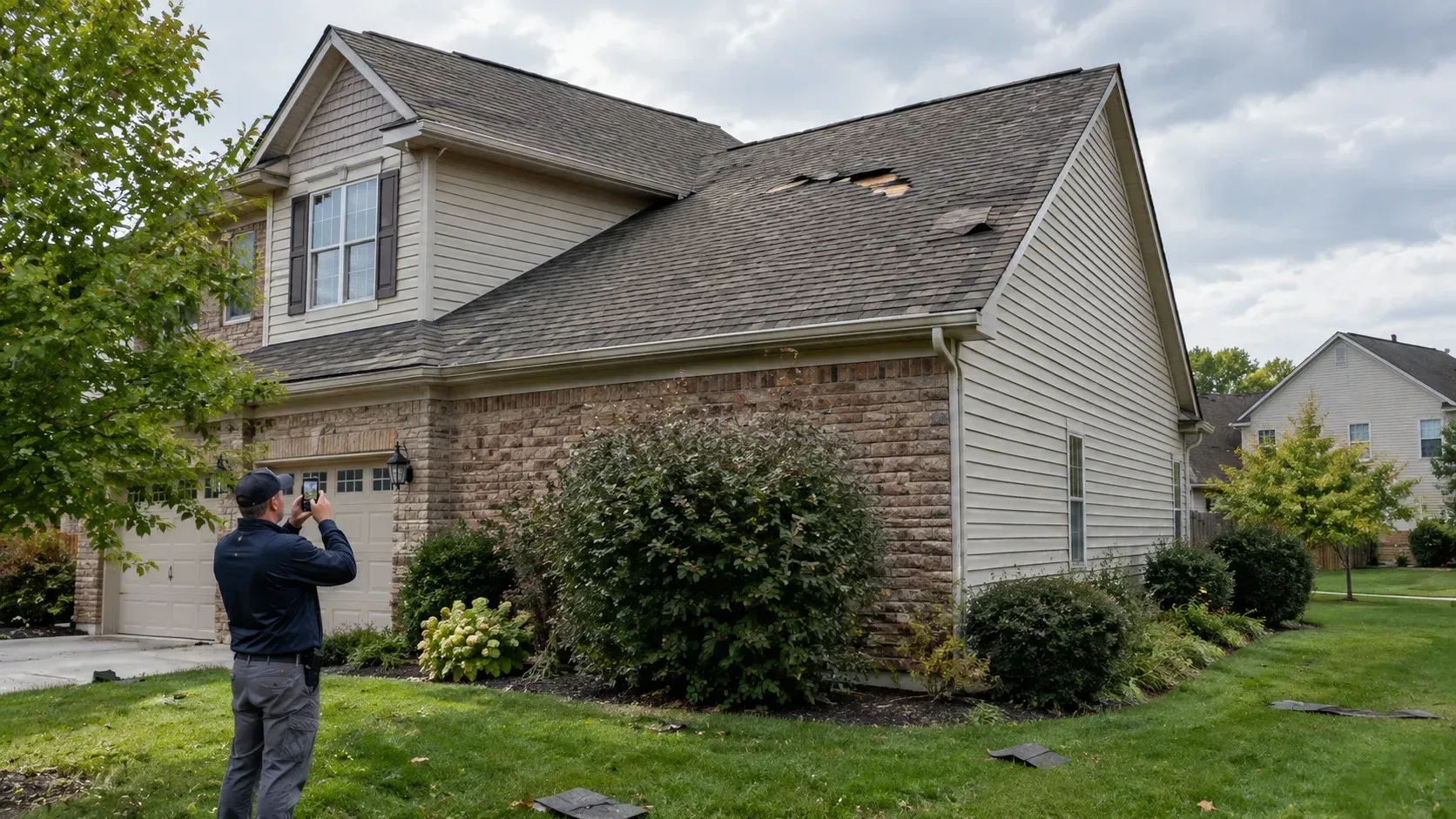
Table of Contents
- Introduction
- Why Missing Shingles After a Windstorm Rarely Mean a Small Repair
- What Wind Actually Does to a Roof
- Hidden Roof Damage After a Wind Storm: The Parts Nobody Sees From the Driveway
- Storm Damage Roof Claim Signs I Look For on a Michigan Roof
- Why the Insurance Company's First Look Often Stops at the Shingles That Blew Off
- What Happens When a Partial Repair Gets Approved and the Rest Shows Up Later
- What To Do in the First Week After a Windstorm
- When a Windstorm Roof Damage Claim Genuinely Is Small
- Conclusion
- Request a Free Roof Damage Consultation Before You File
- Frequently Asked Questions
Key Takeaways
- A handful of missing shingles after a windstorm is usually the visible edge of a wider damage pattern, not the whole loss. The same uplift that tore those shingles off also loosened the ones around them.
- The damage that drives the value of a roof claim is almost always underneath: lifted shingle courses, broken sealant bonds, torn underlayment, backed-out nails, and separated flashing.
- Insurance company adjusters work fast and often price what they can see and reach. What is not documented at the time of inspection tends not to get paid.
- Once you accept a settlement for a small repair, going back later for the rest of the roof is far harder than getting the scope right the first time.
- Photograph everything, keep the shingles that blew into your yard, and get an independent set of eyes on the roof before you agree to a number.
Introduction
I have spent more than 20 years in the insurance business, first on the carrier side and since 2011 on the policyholder side. In that time I have looked at hundreds of Michigan roofs after a storm, and the call I get most often starts the same way: a few shingles came off, the insurance company sent someone out, and the offer that came back covered a small patch job. If a windstorm just went through your neighborhood, my tornado and wind damage claim work exists largely because of how often that patch job turns out to be wrong.
So the short answer is yes. A few missing shingles after a windstorm frequently does signal a much bigger roof claim, and the reason is mechanical rather than opportunistic. Wind does not remove three shingles and politely leave the rest alone. It works on the whole slope, and the shingles that detached are simply the ones that failed first.
Here is what is happening up there, what I look for, and why the difference between a patch and a proper scope of repair is usually decided in the first week after the storm.
Why Missing Shingles After a Windstorm Rarely Mean a Small Repair
An asphalt shingle roof is not a collection of independent pieces. Each course is sealed to the course below it by a strip of adhesive that softens in the sun and bonds the layers into a continuous surface. That bond, plus the nails, is what keeps wind from getting underneath.
When wind hits a slope, it does not push straight down on the shingles. It accelerates over the edge of the roof and creates lift, the same way it does over an aircraft wing. That lift pulls the bottom edge of the shingle upward. Whichever shingles have the weakest bond give way and go into your yard. The ones next to them flex, and their sealant strip breaks even though the shingle stays in place.
That is the whole problem in one sentence. The shingle that left is visible. The shingle that stayed but is no longer sealed looks completely normal from the driveway and is no longer waterproof.
What Wind Actually Does to a Roof
When I get on a roof after a wind event, I am documenting several distinct failure modes, and only one of them is missing shingles:
- Broken sealant bonds. The shingle is still nailed down but no longer adhered to the course below. It lifts by hand. Wind and driven rain can get under it.
- Creased shingles. The shingle folded back during the event and was laid down again by the next gust. The crease is a fracture line in the mat. It will fail, just not today.
- Backed-out or torn-through nails. Repeated flexing works fasteners loose or lets the nail head tear through the shingle mat, leaving a hole in the deck's weather barrier.
- Granule loss along the leading edge. Granules are the shingle's UV protection. Where wind has scoured them off, the asphalt below ages much faster.
- Underlayment tears. The layer between shingles and decking is your second line of defense. Where shingles came off, that layer took the wind directly and often tore.
- Flashing separation. Around chimneys, vents, valleys and wall intersections, wind pressure pulls sealed metal away from the surface it was sealed to.
- Ridge and hip cap displacement. These sit at the highest pressure zone on the roof and are commonly the first thing to move.
None of that requires a hole in your ceiling to be real, covered damage. All of it is why the number attached to a wind claim can move substantially once someone actually looks.
Hidden Roof Damage After a Wind Storm: The Parts Nobody Sees From the Driveway
The reason hidden roof damage after a wind storm causes so many disputes is that its symptoms are delayed. Water does not pour through a broken seal. It seeps, a little at a time, and it travels along the underside of the deck and down the framing before it reaches drywall. By the time you see a stain, you are often months past the storm and the carrier will ask, fairly, how they are supposed to know that stain came from that windstorm.
That is the trap. The evidence linking the water to the wind event is strongest on the day of the storm and weakens every week after.
There is a second layer to this that homeowners rarely think about. Wind damage is often not confined to the roof. When I inspect after a wind event I also check:
- Siding, especially on the windward elevation, for cracked or unseated panels
- Gutters and downslope fascia for pulling and separation
- Soffit and vent panels, which pop out under pressure and let wind and rain into the attic
- Window and door seals on the wind-facing side
- Detached structures, fences and outbuildings, which are frequently covered and frequently forgotten
Several of those show up on the same claim. Hail behaves similarly, which is why I keep hail damage claim documentation on a separate track. Wind and hail often arrive in the same storm and get bundled into one underpriced number.
Storm Damage Roof Claim Signs I Look For on a Michigan Roof
Michigan gives us a specific combination of conditions, and it matters. We get strong straight-line wind events off open ground in the spring and fall, and then we get freeze and thaw cycles all winter. Those two things compound. A sealant bond that broke in an October windstorm spends the next four months with water getting under the shingle, freezing, expanding, and prying it further open.
The storm damage roof claim signs that tell me a loss is larger than it looks:
- Shingles anywhere on the slope that lift by hand with almost no resistance
- A clean, straight line of damage running with the prevailing wind direction rather than a random scatter
- Shingle debris in the yard that still has its sealant strip intact and clean, which shows the bond failed rather than the shingle tearing apart with age
- Exposed nail heads or fastener holes in the deck where shingles pulled free
- Fresh, sharp-edged creases with bright asphalt visible in the fold
- Damage concentrated at rakes, eaves, ridges and corners, which is exactly where uplift pressure is highest
- Neighbors on the same street with confirmed roof damage from the same event
That last one carries more weight than people expect. A documented pattern across a block is difficult for a carrier to characterize as isolated wear.
Why the Insurance Company's First Look Often Stops at the Shingles That Blew Off
I want to be careful here. I spent two decades inside this industry and I do not think most adjusters act in bad faith. The structural reality is simpler than that.
After a significant storm, a carrier's adjusters are handling a heavy volume of claims in a compressed window. An inspection has to be efficient. The missing shingles are obvious, countable and easy to price. A broken sealant bond three courses up requires someone to walk the slope and lift shingles by hand, and it produces a much larger and harder-to-defend estimate.
There is also a genuine interpretive question. Carriers frequently attribute lifted or unsealed shingles to age, prior wear or manufacturing rather than to the storm. Sometimes that is a reasonable position. Often it is not, and the difference comes down to whether anyone documented the damage pattern well enough to argue about it. Our FAQ page covers how that documentation burden falls on the policyholder rather than the insurer.
The practical consequence is this: what does not get written into the inspection report generally does not get into the settlement.
What Happens When a Partial Repair Gets Approved and the Rest Shows Up Later
This is the part I most want homeowners to understand before they sign anything, because it is where the real money is lost.
Say the offer covers replacing the shingles that blew off. You accept it, a roofer patches the area, and everything looks fine. Eight months later a stain appears on a bedroom ceiling on the other side of the same slope, from a seal that broke in the same windstorm.
Reopening that claim means proving three things at once: that the new damage exists, that it was caused by the original storm rather than anything in the eight months since, and that it was not already accounted for in the settlement you accepted. Each of those is harder than it would have been on day three. Meanwhile the repair itself has become more expensive, because water has now been in the deck and possibly the insulation and drywall.
There is a related complication with matching. If a patch is done in one area and the full slope needs replacing later, the shingles will not match, and whether the carrier owes for a uniform appearance is its own argument you would rather not be having.
Getting the scope right at the start is not about maximizing a number. It is about not having this conversation twice.
What To Do in the First Week After a Windstorm
The window where evidence is strongest is short. In order of priority:
- Stay off the roof. Storm-damaged roofs are genuinely dangerous, and a fall is worse than any claim outcome. Document from the ground and from windows.
- Photograph immediately and widely. Every elevation of the house, the yard, the debris, and any interior area with moisture. Wide shots for context, close shots for detail. Your phone timestamps everything, which is the point.
- Keep the shingles that blew off. Do not throw them out. The condition of the sealant strip on a detached shingle is real physical evidence about how it failed.
- Write down the date and time of the storm and save any local weather reporting for that event.
- Make reasonable temporary repairs to prevent further damage, such as tarping, and keep every receipt. Do not begin permanent repairs.
- Report the loss to your carrier promptly. Policies contain notice requirements, and delay creates an argument you do not need.
- Get an independent inspection before you agree to a settlement figure, not after. This is the single step that changes outcomes most.
Homeowners across Oakland County deal with this pattern every storm season, which is why our Rochester Hills claim work leans so heavily on wind and roof losses.
When a Windstorm Roof Damage Claim Genuinely Is Small
I am not going to tell you every wind claim is bigger than it looks, because that is not true and it would not be a useful thing to hear from me.
Some windstorm roof damage really is confined. If a single shingle at a rake edge lifted, the surrounding courses are firmly sealed when checked by hand, the underlayment is intact, there is no creasing or fastener damage anywhere on the slope, and the roof is relatively new, then a small repair is the correct outcome and there is nothing further to pursue.
Some claims are also small enough that the deductible eats most of the repair cost, in which case filing may not serve you at all. As our FAQ page puts it, if we do not believe our involvement in your claim will make a difference, we will tell you right up front.
The difference between the small claim and the large one is not something you can determine from the driveway. It is determined by someone walking the slope and lifting shingles. That inspection is the whole decision.
Conclusion
A few missing shingles is a symptom, not a diagnosis. Wind uplift damages the shingles it removes and the shingles it leaves behind, and the second group is what determines whether you are looking at a patch or a slope. Because the unsealed shingle looks normal and leaks slowly, the gap between what was visible on inspection day and what was actually damaged tends to surface months later, when proving the connection is much harder and the repair costs more.
Document aggressively in the first week, keep the physical evidence, and have someone look at the whole roof before you accept a number for part of it.
Request a Free Roof Damage Consultation Before You File
If a windstorm has moved through your area and you are looking at missing shingles, do not accept a patch estimate until someone has checked the rest of the slope. I offer a free, no obligation consultation to walk through what happened to your roof, what your policy actually covers, and whether a claim is worth filing at all.
Up Front Settlements works only for policyholders, never for insurance companies. Our fee is a percentage of the settlement we recover, so if you do not get paid, we do not get paid. Call (248) 841-5674 or reach us through the
contact page to get on the schedule.
Frequently Asked Questions
How many missing shingles does it take to file a wind damage claim?
There is no threshold number. What matters is the total scope of damage, including unsealed and creased shingles that are still in place, compared with your deductible. A slope with three missing shingles and thirty broken seals is a substantial claim.
Will my insurance company pay to replace the whole roof or just the damaged shingles?
It depends on the documented extent of damage and your policy language. Carriers generally price repairs unless the damage across a slope is broad enough to make repair impractical, which is why documenting unsealed and creased shingles matters so much.
Can I still file if the windstorm was several months ago?
Often yes, though it gets harder. Policies contain prompt-notice requirements and the older the loss, the more room a carrier has to attribute damage to something after the storm. File as soon as you know, and bring whatever dated photos you have.
Does a roofer's estimate carry the same weight as an adjuster's inspection?
They serve different purposes. A roofer prices repairs. A public adjuster documents the loss against your specific policy language and negotiates the claim. Carriers respond to policy-based damage documentation, not to a repair quote alone.
Is wind damage to siding and gutters part of the same claim as the roof?
Usually yes. Wind damage is one event, and siding, gutters, soffit, fencing and detached structures damaged in the same storm generally belong on the same claim. They are also the items most often left off the initial estimate.