Is It Actually Legal for a Public Adjuster to Charge a Percentage of Your Insurance Settlement?
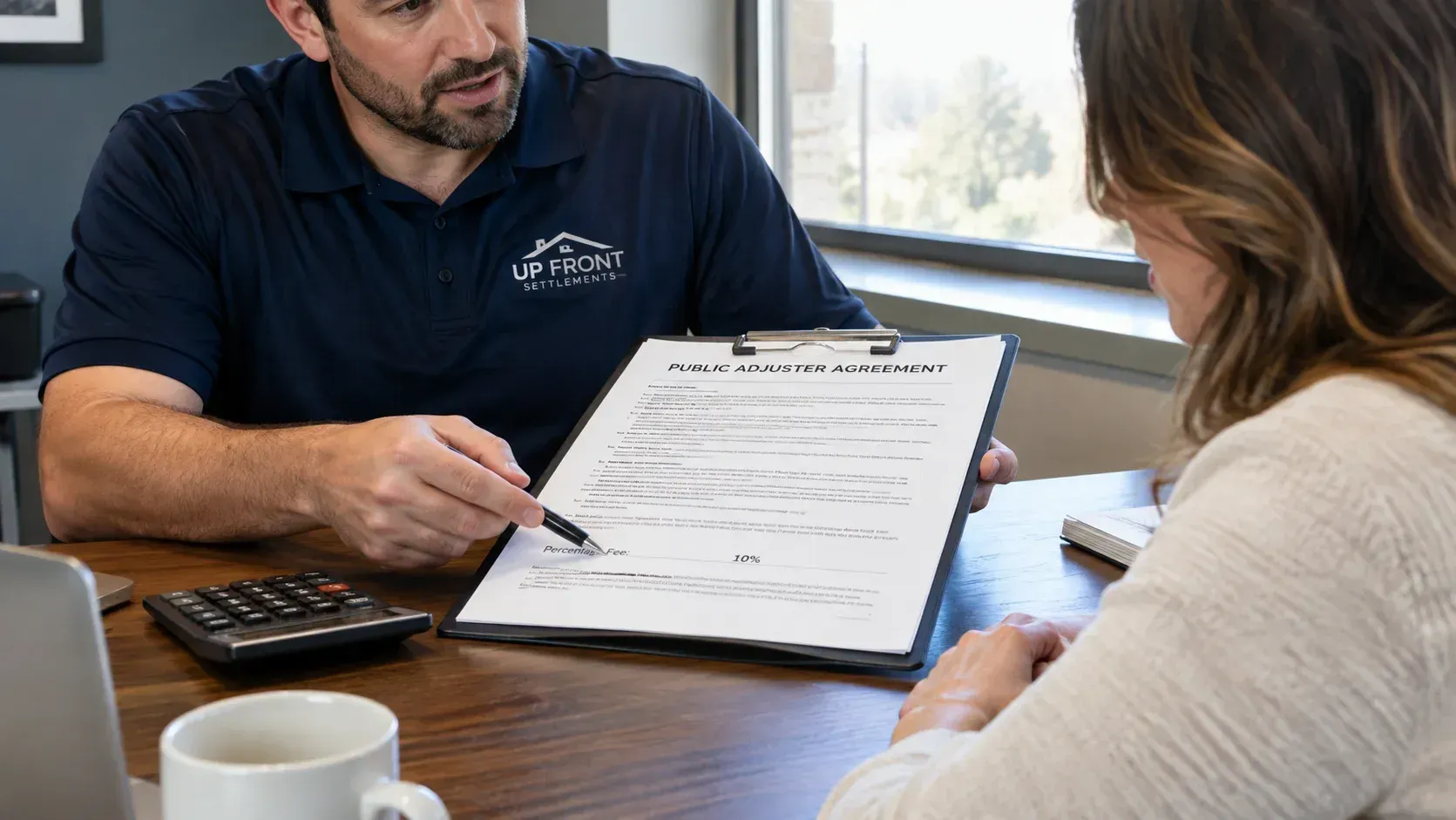
Table of Contents
- Introduction
- The Short Answer
- What a Public Adjuster Actually Is, and Who They Work For
- Why It Is Legal for a Public Adjuster to Charge a Percentage
- How Public Adjusters Get Paid, Step by Step
- What Your Public Adjuster Fee Agreement Must Tell You
- Why the Contingency Model Exists at All
- What Public Adjuster Fees Do Not Cover
- Questions to Ask Before You Sign Any Public Adjuster Contract
- When Hiring a Public Adjuster Is Not Worth the Fee
- Conclusion
- Ask About Our Contingency Fee Before You Sign Anything
- Frequently Asked Questions
Key Takeaways
- Yes, it is legal. Public adjusters are licensed professionals, and the percentage-of-settlement fee is a state-regulated compensation model, not a loophole.
- The fee must be set out in a written contract you sign before any work starts. If someone will not put the percentage in writing, that is your signal to walk away.
- Contingency means the fee comes out of the settlement. If you do not get paid, we do not get paid.
- The percentage is not universal. It varies by state rules, claim type, claim size and complexity, and some states cap it after a declared disaster.
- A public adjuster is not the same as an insurance company adjuster or an independent adjuster. Only the public adjuster works for you.
Introduction
I get this question in some form on nearly every first call, and I am glad when people ask it. A stranger offering to take a percentage of your insurance money should raise an eyebrow. I spent more than 20 years working for major insurance companies before I opened my own firm in 2011, so I understand exactly why the arrangement sounds like something worth double checking.
Yes, it is legal. Public adjusters are licensed and regulated professionals, and the contingency-fee, percentage-of-settlement model is a recognized and state-supervised way for them to be paid. That is precisely why the fee has to be disclosed in a written contract before any work begins.
Below is how the model actually works, what regulators require of it, what the fee does and does not cover, and how to tell a legitimate agreement from one you should not sign.
The Short Answer
A public adjuster is a licensed insurance professional who represents the policyholder rather than the insurer. State insurance departments license them, set the rules for how they may solicit business, and regulate how they may be compensated. The percentage-of-settlement arrangement is legal because the state has expressly built rules around it, including written-contract and disclosure requirements.
What is not legal, and what those rules exist to prevent, is an undisclosed fee, an unlicensed person adjusting your claim, or a fee taken from a settlement without a signed agreement authorizing it. The regulation is not aimed at the percentage. It is aimed at making sure you know the percentage before you agree to it.
What a Public Adjuster Actually Is, and Who They Work For
This matters more than the fee question, and most people have never had it explained. There are three kinds of property insurance adjuster:
- Company adjusters are employees of your insurance company. They work for the insurer.
- Independent adjusters are contractors hired by insurance companies to handle claims on the carrier's behalf. Despite the name, they also work for the insurer.
- Public adjusters are licensed to represent policyholders. As our FAQ page states, public adjusters are the only category of insurance adjuster who work exclusively for you, the policyholder.
I have worked both sides of that line. On the carrier side, my job was to evaluate a claim on behalf of the company paying it. That is a legitimate job and a necessary one. But it is not the same job as building your claim as thoroughly as your policy allows, and nobody should expect one person to do both.
That structural gap is the reason my profession exists, and it is the reason regulators permit contingency compensation. Someone has to be able to do this work for a policyholder who has just lost a roof and has no cash on hand.
Why It Is Legal for a Public Adjuster to Charge a Percentage
The legality rests on a few things, all of which you can verify:
- Licensing. Public adjusters must hold a state license to adjust claims on a policyholder's behalf. Licensing brings the licensee under the state insurance department's authority, including its rules on compensation.
- Statutory recognition of the fee model. States that license public adjusters generally address compensation directly in their rules, rather than leaving it to private arrangement. A model the state writes rules for is by definition a permitted model.
- Mandatory written contracts. The fee arrangement has to exist as a signed, written agreement. This is the core consumer protection and the reason the arrangement is not open to abuse.
- Disclosure before engagement. The percentage must be stated to you before work begins, not calculated afterward.
- Fee caps in defined circumstances. Many states cap public adjuster fees, and a number of them impose stricter caps on claims arising from a declared catastrophe, specifically so that fees cannot spike when policyholders are most desperate.
So when someone asks whether a public adjuster charge of this kind is legal, the accurate answer is that it is legal and supervised. The percentage is not a gray area. An undisclosed or unwritten fee would be.
I am deliberately not quoting a specific percentage cap or statute number here, because these rules are set state by state and change. Michigan and Ohio each have their own. Ask any public adjuster you speak with to tell you their license number and the state rule that governs their fee, and verify it with the state insurance department directly. A legitimate adjuster will hand that over without hesitation.
How Public Adjusters Get Paid, Step by Step
The public adjuster fee structure in Michigan and in most states follows the same sequence:
- Free initial consultation. We look at your loss and your policy and tell you whether we think we can add value. No fee attaches to this conversation.
- Written contract. If you want to move forward, you sign an agreement that states the percentage, what claim it applies to, and what the scope of work is. Read it. Ask questions about it.
- We do the work. Policy review, damage documentation, estimate preparation, claim presentation, and negotiation with your insurance company.
- The insurer issues the settlement. The fee is calculated as the agreed percentage of that settlement.
- The fee is paid out of the settlement proceeds. You do not write a check from your own funds up front.
This is what contingency means in practice, and it cuts both ways. If the claim recovers nothing, there is nothing to take a percentage of. If you don't get paid, we don't get paid. That alignment is the entire point of the model, and it is why I will tell a homeowner honestly when their claim does not need me.
What Your Public Adjuster Fee Agreement Must Tell You
Before you sign, the document in front of you should clearly answer all of the following. If any of it is missing or vague, do not sign it:
- The exact percentage, stated as a number
- Whether the percentage applies to the total settlement or only to the amount recovered above the insurer's existing offer
- Which claim and which loss date the agreement covers
- What happens to amounts the insurer had already paid or offered before you hired the adjuster
- The scope of services included
- Your right to cancel, and the window for doing so
- The adjuster's name, license number and licensing state
- Whether any costs beyond the fee itself, such as engineering or specialist reports, may be charged, and whether you must approve them first
That second point catches people out and is worth understanding. There is a meaningful difference between a percentage of the entire claim and a percentage of the increase a public adjuster obtains. Both structures exist. Neither is inherently wrong. But you should know which one you are signing, because on a claim where the insurer has already offered a substantial amount, the two produce very different numbers.
Why the Contingency Model Exists at All
Consider the alternative. If public adjusters billed hourly, then the only policyholders who could hire one would be those with money available immediately after a fire, a flood or a tornado. That is close to the opposite of who needs the help.
Contingency removes the up-front cost barrier, which is the same reason it is standard in other areas of consumer representation. It also does something regulators care about: it ties the adjuster's compensation to the outcome, so there is no incentive to run up hours on a claim that is going nowhere.
In 2014 a tornado destroyed my own family home, and I went through this process as the policyholder rather than the professional. That experience is a large part of why I am comfortable defending this model. What you need at that moment is somebody competent working on your side immediately, not an invoice.
What Public Adjuster Fees Do Not Cover
A percentage fee buys claim representation. It does not buy the following, and no honest adjuster will imply otherwise:
- Repairs. The fee is for handling the claim. Contractors, restoration companies and roofers bill separately, and we do not perform the repairs.
- Legal representation. Public adjusters are not attorneys and cannot litigate. If a claim requires a lawsuit or a bad-faith action, that is an attorney's work.
- A guaranteed outcome. Nobody can promise a settlement amount. If someone does, that alone should end the conversation.
- Coverage that does not exist in your policy. We can make sure everything covered is claimed and correctly valued. We cannot create coverage you did not buy.
- Your deductible. That remains yours regardless of who handles the claim.
Questions to Ask Before You Sign Any Public Adjuster Contract
Ask all of these. Any adjuster worth hiring will welcome them:
- What is your license number, and in which states are you licensed?
- Is your percentage applied to the total settlement or to the amount recovered above the current offer?
- Have you handled my specific type of loss, and can you describe a comparable claim?
- Who exactly will handle my file day to day?
- What is your fee if the insurer pays nothing more than it has already offered?
- Can I cancel, and what happens to the fee if I do?
- Will you tell me if you think I do not need you?
That last question is the one I would ask. Our answer is on the FAQ page: if we do not believe our involvement in your claim will make a difference, we will tell you right up front.
When Hiring a Public Adjuster Is Not Worth the Fee
I would rather say this clearly than have you find out later.
If your claim is small, straightforward, and the insurer has already offered an amount close to what the repairs actually cost, a percentage fee may not leave you better off. A single damaged window with a clean estimate and a fair offer does not need me. Neither does a loss that falls at or below your deductible.
Where a public adjuster earns the fee is on claims with real complexity or real disagreement: a large or total loss, damage that is partly hidden, a denial, a dispute over scope, contents and personal property inventories, business income losses, or a claim that has stalled. Our residential claim work and commercial claim work both concentrate there, because that is where the gap between the first offer and the actual loss tends to be widest.
Run the arithmetic honestly before you sign. If the fee exceeds the likely improvement in your settlement, do not hire anyone.
Conclusion
The percentage-of-settlement fee is legal because states license public adjusters and write rules around exactly how they may be compensated. Those rules require a written contract and up-front disclosure, which is what separates a regulated professional fee from something you should be suspicious of.
The real questions are not whether the model is legal. They are whether the adjuster in front of you is licensed, whether the percentage and its basis are stated plainly in writing, and whether your particular claim is complex enough that representation will actually leave you better off. Ask for the license number, read the agreement, and expect a straight answer about whether you need the help at all.
Ask About Our Contingency Fee Before You Sign Anything
If you are weighing whether to hire a public adjuster, call and ask us about the fee before you commit to anything. I will tell you the percentage, what it applies to, and whether I think your claim needs us at all.
Up Front Settlements has represented policyholders across Michigan and Ohio since 2011, and we work only for policyholders, never for insurance companies. Our
team of licensed public adjusters operates on contingency, so the fee comes out of the settlement we recover. Call (248) 841-5674 or reach us through the
contact page for a free, no obligation consultation.
Frequently Asked Questions
What percentage does a public adjuster usually charge?
It varies by state rules, claim type, claim size and complexity, so no single figure applies everywhere. Many states also cap fees, with stricter caps after a declared disaster. Ask for the exact percentage in writing before you sign, and confirm what it applies to.
Do I pay a public adjuster if my claim is denied and nothing is recovered?
Under a contingency agreement, no. The fee is a percentage of the settlement, so if nothing is recovered there is nothing to take a percentage of. Confirm this in your written contract, and check whether any separate costs such as specialist reports are treated differently.
Is a public adjuster's fee negotiable?
Sometimes, particularly on larger or more complex claims, though state caps and the firm's own policy set the limits. What matters more than negotiating the number is understanding whether it applies to the whole settlement or only to the amount recovered above the insurer's existing offer.
Can my insurance company refuse to work with a public adjuster?
No. You have the right to be represented on your own claim. Your insurer must communicate with your licensed representative once you have notified them of the representation, though it may still dispute the claim itself on the merits.
How do I verify that a public adjuster is actually licensed?
Ask for the license number and licensing state, then confirm it directly with that state's department of insurance, which maintains a public licensee lookup. Do this before signing. A legitimate adjuster will give you the number without hesitation.